

Case Study: 480,000 Streams and Yandex Nitro Through TikTok UGC Sound Seeding

This is the story of how independent artist PashAnanda used UGC sound seeding by real creators on TikTok to reach 480,000+ streams on Yandex Music in a single month and earn a spot in the Yandex Nitro program. No label, a minimal budget, no marketing team — just living authors who filmed short clips on their own accounts, and a strategy for warming up a cold sound.
⚠️ Important: Results depend on the quality of the track, the niche, and the platforms' current algorithms. This case study is not a guarantee — it's a real example of a strategy you can adapt.
The challenge: promote music on a minimal budget
It's the classic situation for an indie artist: the track is recorded, mixed, and uploaded to streaming — and then silence. Without promotion, even good music drowns in the daily flood of releases.
The promotion options looked like this:
- Bloggers and influencers — anywhere from 5,000 to 150,000 rubles per placement, with unpredictable results
- Targeted ads — expensive, with low conversion into streams
- Organic growth — slow and doesn't scale
- UGC sound seeding on TikTok — real creators pick up the track and post short videos on their own accounts
PashAnanda chose the last path. The idea is simple: the more living authors use your music on TikTok, the higher the chance that the algorithm catches one of the clips and sets off a chain reaction.
The strategy: 498 videos for a single song
The key hypothesis — volume wins. Instead of one "perfect" video that may never take off, we seed the track across hundreds of real creators. The goal isn't a single viral clip — it's a mass organic signal for the algorithm: hundreds of living accounts using one sound over a short period.
Each individual video earns its standard 200–500 views. But the power isn't in the individual clips — it's in their mass. 498 videos using one sound painted a picture of an emerging trend for the TikTok algorithm. It was precisely the cumulative effect — hundreds of uses of one sound by real authors over a short period — that gave the track a chance at an organic pickup by the platform.
How does this turn into streams?
An important point: the sound is uploaded to TikTok officially. That means when a user hears the track in a video, they can tap on the sound and immediately see the artist's name, cover art, and link. TikTok automatically links the official sound to the artist's profile on streaming platforms.
- TikTok's algorithm tests every video separately — even a small account's video gets 200–500 impressions to assess engagement
- Different audiences — hundreds of videos from different creators land in different user segments, expanding the sound's reach
- The snowball effect — when TikTok sees a track being used across many videos, it begins promoting it as a trending sound
- Direct path to streaming — a user hears the track → taps the sound → sees the artist → heads over to listen on Yandex Music, Spotify, or Apple Music
The content approach: clips you want to watch to the end
All ~500 videos were prepared around the track, with one task: give creators visuals that hold attention and earn high watch-through. The higher the watch-through, the stronger the organic signal the algorithm sees.
Three categories of video:
- Dancing women — around 40 videos. Aesthetic, hypnotic, attention-grabbing
- Oddly satisfying clips — 50–100 videos: satisfying cuts, abstract visuals, aesthetics. Content you want to watch to the end
- Mood videos — 50–100 videos: someone skiing, snowboarding, flying in a helicopter, skydiving. Atmospheric visuals set to the music
Text overlays are added on top of the visuals — this gives control over the message and boosts engagement. The output is a vertical 9:16 format, ready for the creator to publish on their own account.
Here's an example of one such video on TikTok.
How the seeding runs: real creators through KotKit Market
Seeding a track across hundreds of living authors by hand, negotiating with each one individually, is nearly impossible. The whole process comes down to three links in a chain.
Preparing content around the track
The first stage is the video assets built for the sound: dancing figures, satisfying scenes, dynamic shots. The output is hundreds of visual variants, each one different but with the same track. All the creator has to do is choose a clip, add their own touch if they want, and publish it on their account.
KotKit Market — the platform where real creators claim the task
KotKit Market is a marketplace where the artist posts a task — "film/publish a short video with this track" — and living authors claim it and complete it on their own TikTok accounts. No bots, no emulators, no automation, no fake engagement — only real people who publish the clip themselves.
What happens on the platform:
- The artist posts a task with the track and a budget
- Real creators claim slots and publish videos on their own accounts
- The seeding spreads out naturally over time — 20–40 posts per day
- Every publication produces a verifiable link to a live clip
Verification: a checkable link for every clip
The final link in the chain is the confirmation that each publication is real and live. These are real people on real accounts, not fake engagement.
How it works:
- Living authors, not bots — every clip is published by a real person from their own account. No emulators, no API hacks
- Hundreds of real accounts — videos spread across different authors and their audiences, expanding the sound's reach
- A natural rhythm — posts go live at different times, like the ordinary activity of real users
- Verifiable links — every publication has a link to a live clip on TikTok; after 24 hours the system checks that the post is still there
What the full path looks like
The path from track to streams:
- Step 1: Prepare hundreds of video variants built around the track
- Step 2: Post the task on KotKit Market → real creators claim slots
- Step 3: Living authors publish 20–40 videos per day on their own accounts
- Step 4: TikTok users hear the track → tap the sound → see the artist → go listen on streaming
- Step 5: Streams grow on Yandex Music → placement in algorithmic playlists → Yandex Nitro
Once the campaign launches, the seeding runs on its own: real creators pick up the tasks, and the artist can focus on the music while the track spreads across accounts.
Results: the numbers
TikTok
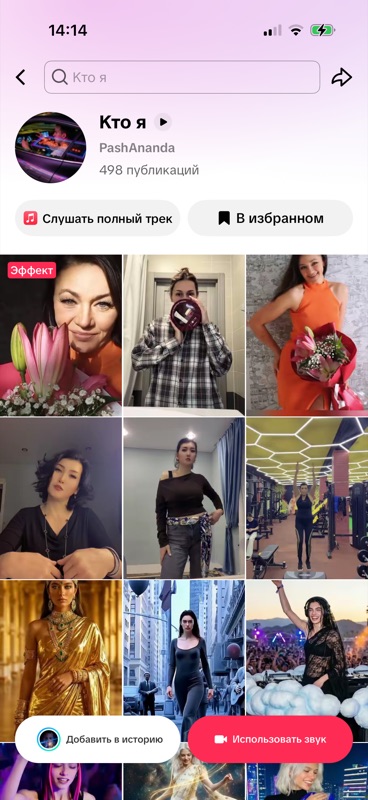
- 498 videos published for the single song "Who Am I" ("Кто я")
- 20–40 videos per day — a steady publishing pace
- Reach for videos with this sound began to grow organically — clips using the track started appearing more often in recommendations
- Individual users began creating their own videos with the track
Yandex Music
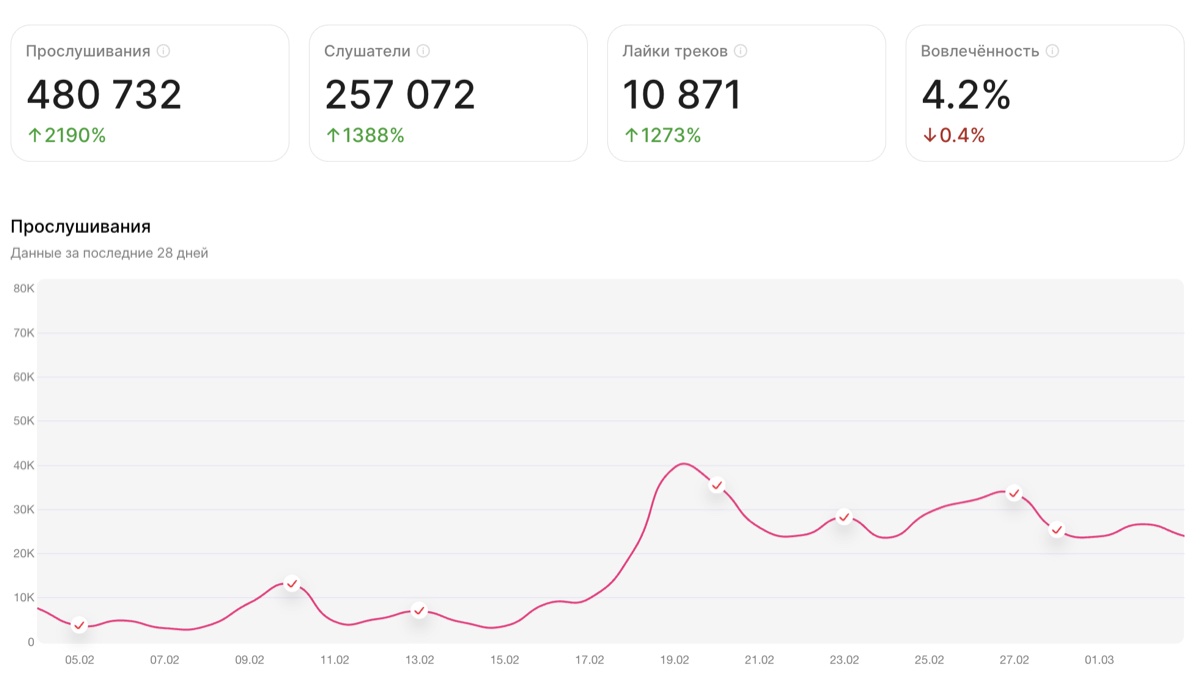
- 480,732 streams in 28 days (+2,190%)
- 257,072 listeners in 28 days (+1,388%)
- 10,871 likes on the track (+1,273%)
- 466,772 streams over 180 days — nearly all of the growth came in the last month
- Entry into the Yandex Nitro program — algorithmic promotion from Yandex itself
- The track landed in automatic playlists
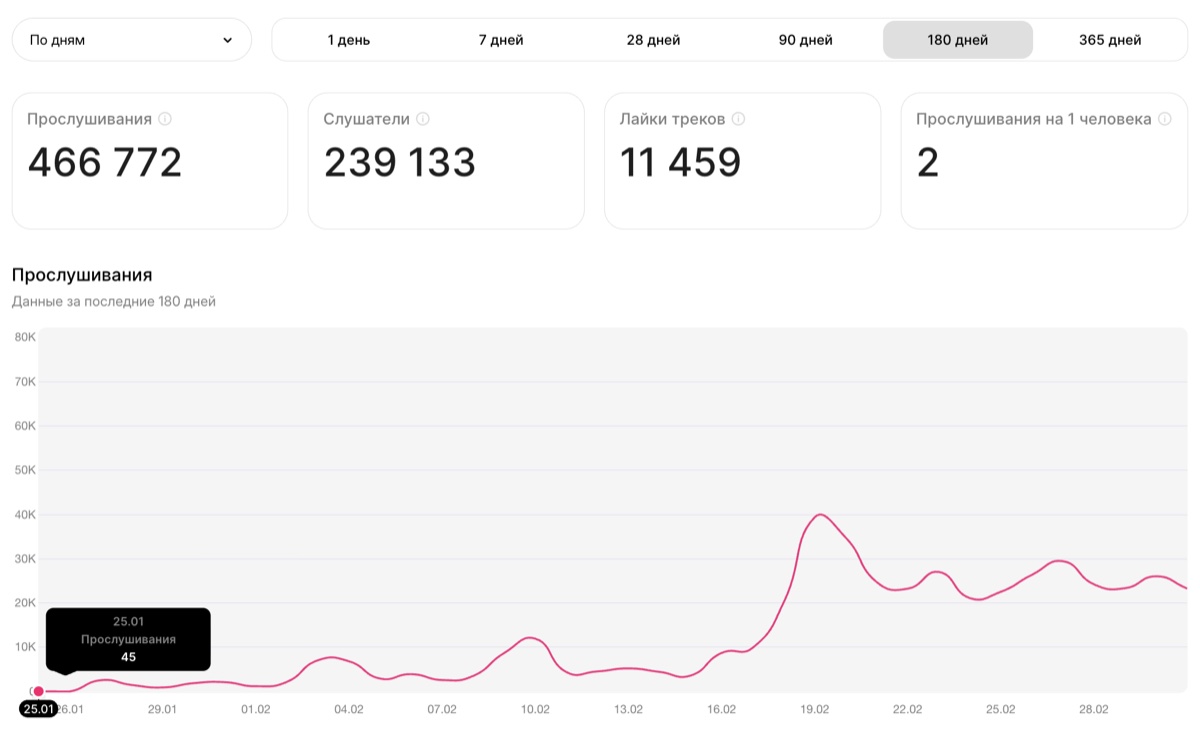
When TikTok starts recommending your music on its own — that's the turning point. Before that, you publish videos and hope. After that, the algorithm picks it up, and streams on the platforms start growing exponentially.
What is Yandex Nitro?
Yandex Nitro is an artist support program from Yandex Music. Getting into it means the platform begins actively promoting your tracks: adding them to editorial playlists, recommending them in personal mixes, and giving them priority in the algorithm.
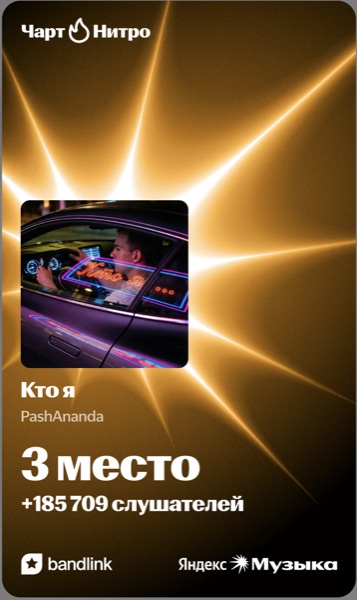
The track "Who Am I" reached 3rd place on the Nitro Chart with a gain of +185,709 listeners:
You can make it into Nitro when a track shows steady organic growth. UGC sound seeding on TikTok was the trigger that set off the chain: TikTok → streaming growth → Yandex Nitro.
Why TikTok picks up a track after hundreds of videos
In 2021, an internal TikTok document for employees leaked online — TikTok Algo 101. From it, we learned that the algorithm scores content with the formula "Likes + Comments + Watch Time + Watch-Through." When different real accounts use the same sound and the audience watches it to the end, the system gives the sound a "trend check mark." That organic signal is exactly what mass seeding by living authors produces.
It's not magic — it's the mechanics of the algorithm.
- A signal of sound popularity. When the same official audio track is used in hundreds of videos by real authors, TikTok reads it as a trend. The platform starts boosting videos with that sound.
- Audience diversity. Hundreds of videos from different accounts reach different user segments. Each gets its own 200–500 test views — but together that's tens of thousands of contact points with different audiences.
- Engagement accumulates. The total likes, comments, and shares across all the videos create a "critical mass" of interest in the track.
- The UGC effect. When ordinary users start using your track in their own videos — that's the final trigger for the algorithm. TikTok begins recommending it as a trending sound.
What it costs: a comparison with other methods
An objective comparison of the costs of promoting a track:
- Bloggers: 50,000 — 500,000 rubles per campaign, with unpredictable results.
- Targeted ads on VK/Telegram: 30,000 — 100,000 rubles, with low conversion into streams (users don't go to streaming from an ad).
- UGC seeding through KotKit: Campaigns from 5,000 rubles (50 videos). The "Boost" package — 100 videos for 9,000 rubles. A scalable approach: the more living authors pick up the track, the stronger the cumulative organic signal for the algorithm.
The main advantage of UGC seeding is scalability. A blogger publishes one post. The marketplace delivers 20–40 publications per day from different real authors, every day. And with KotKit you can test a strategy on a minimal budget and scale up only what works.
Want the same result?
The entire seeding effort from this case study — sourcing real creators, publishing on their accounts, verifying the posts — is a turnkey service. You don't need to find authors by hand and negotiate with each one. We take that on for you.
What we do for you
- We prepare the videos — as a bonus, we'll build the content around your track: satisfying visuals, text overlays, vertical 9:16 format
- We seed it across real creators — hundreds of living authors publish your video on their own accounts, and TikTok sees the organic signal
- We verify every post — each publication comes with a checkable link; after 24 hours the system confirms the post is still live. If it's deleted, you don't pay
What it looks like for you
- Send the video (or we'll prepare it) and set a budget
- Posts appear within an hour — real accounts of living authors; publications are labeled in accordance with legal requirements and platform rules
- Pay for results — only for live publications, after verification
Campaigns from 5,000 rubles (50 videos). The "Boost" package — 100 videos for 9,000 rubles. Pick a package on the marketplace or message us on Telegram.
Who it's for
- Independent musicians — promoting singles and albums without a label or budget
- Music labels — large-scale promotion of an artist catalog
- Beatmakers — promoting instrumentals through TikTok
- Brands and SMM agencies — UGC seeding and music promotion for clients
We don't work with grey verticals — only legal content, real authors, and white-hat promotion methods.
Conclusion
The PashAnanda case study shows that promoting music in 2026 doesn't require a million-ruble budget. It requires a strategy, content, and the right tool.
498 videos from real creators → growing sound reach on TikTok → 480,000+ streams on Yandex Music → Yandex Nitro.
We handle the content prep, the seeding across living authors, and the verification — you get verifiable publications and streaming growth. It works for any artist, producer, or brand looking to scale their presence on TikTok.
Launch UGC sound seeding for your music — campaigns from 5,000 rubles, first posts within an hour.
Related posts
Pre-Save as the Engine of First-Week Streams: A 14% Conversion Case
How to turn teaser reach into predictable first-week streams via pre-save. A breakdown of one indie release: 14,700 pre-saves in two weeks, 14% conversion to first stream, and a step-by-step playbook.
TipBest Release Day in 2026: Friday or Weekday — What Yandex Music and VK Data Actually Say
Friday has long been the industry default, but the rules shifted in 2026. We break down how the Yandex Music, VK and TikTok algorithms react to day of week, which window delivers the most first-week streams, and when to release if you are running a UGC campaign.
GuideHow to Promote Music on TikTok From Russia in 2026
How a Russian artist promotes a track on TikTok in 2026 through real creators: UGC seeding of the sound by live authors, warming up a cold track, and giving the algorithm a chance to pick it up. Plus — how that turns into streams on Yandex Music.